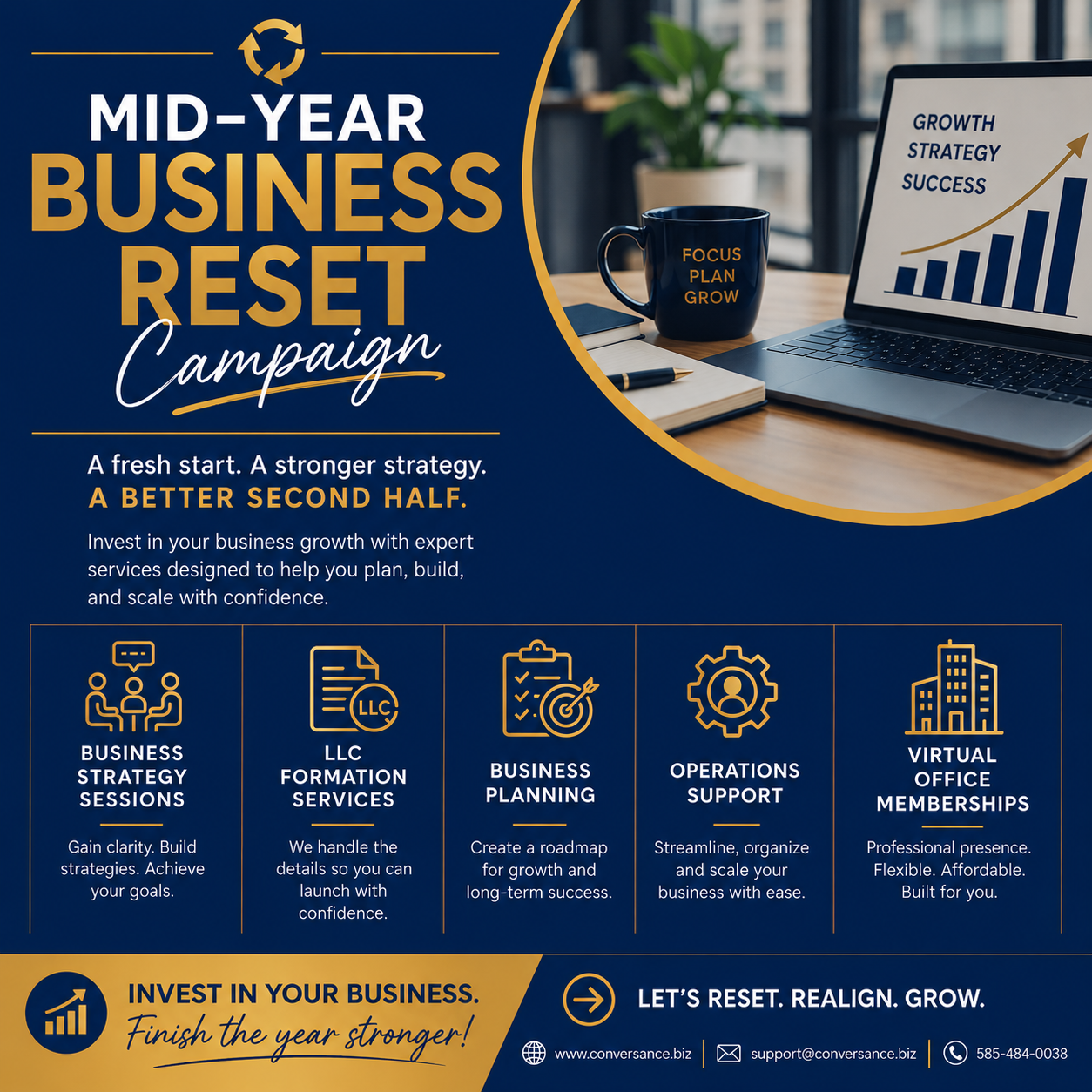
Mid-Year Business Reset
Mid-Year Business Reset: Why the Next Six Months Matter More Than the First Six
Written by Rumella Cameron, Founder & CEO of Conversance Business Solutions
I can’t believe we’re already halfway through 2026.
A Mid-Year Business Reset may be one of the most valuable exercises a business owner can complete. As we enter June and officially reach the halfway point of 2026, now is the perfect time to slow down, reassess, and ensure you’re still aligned with the goals you set at the beginning of the year.
Time has a way of moving much faster than we expect. It feels like just yesterday many of us were sitting down with a fresh notebook, a new planner, or a vision board, outlining our goals for the year ahead. We are excited, motivated, and focused. We had a clear picture of what we wanted to accomplish and a plan to get there.
Then life happened.
Clients needed attention. Deadlines had to be met. Unexpected challenges arose. Opportunities appeared that weren’t part of the original plan. Before we knew it, January became June.
As entrepreneurs and business owners, it is easy to become consumed by the daily demands of running a business. We spend our days solving problems, serving customers, managing operations, responding to emails, attending meetings, and putting out fires. We become so focused on keeping things moving forward that we rarely stop long enough to ask ourselves a very important question:
Am I still moving in the direction I originally intended?
That’s why I believe the midpoint of the year is one of the most important times for business owners. Not because it marks six months completed, but because it provides an opportunity to pause, reflect, and intentionally reset before the year gets away from us completely.

Why Mid-Year Matters
Too often, entrepreneurs treat business growth as a straight line. They assume that once goals are established in January, success simply becomes a matter of working harder. In reality, business growth is rarely linear. Markets shift. Priorities change. Customers evolve. Businesses mature. New opportunities emerge.
Successful entrepreneurs understand that growth requires periodic reassessment.
A mid-year reset isn’t about admitting failure.
It’s about making sure your actions remain aligned with your goals.
One of the biggest lessons I’ve learned over the years is that businesses rarely struggle because of a lack of ambition.
Most entrepreneurs I meet are highly motivated. They’re willing to work long hours, make sacrifices, and invest in themselves and their businesses. The challenge is rarely motivation. More often, the challenge is structure. Without the right systems, processes, and support in place, even the most ambitious business owners can find themselves overwhelmed and struggling to scale.
Growth Creates Complexity
At Conversance, we work with entrepreneurs across a variety of industries. While every business is unique, many owners face similar challenges. They find themselves wearing too many hats, operating without documented systems, and relying heavily on their own involvement to keep the business moving forward. As a result, growth becomes difficult to sustain because the infrastructure needed to support expansion simply isn’t there.
What often starts as a successful business can quickly become overwhelming when growth outpaces operations. New clients bring additional responsibilities. New services require new processes. Additional team members create new management and communication demands. While growth is something every entrepreneur strives for, it also introduces complexity that must be managed intentionally.
Without the right systems and structure in place, business owners often find themselves spending more time reacting to challenges than planning for the future. They become trapped in the day-to-day demands of the business, leaving little room for strategic thinking, business development, or long-term planning.
That’s why I encourage business owners to look beyond revenue alone and evaluate the overall health of their business. Revenue and profitability are important indicators of success, but sustainable growth requires much more than sales. It requires documented processes, operational efficiency, accountability, strong leadership, and a clear plan for scaling. The businesses that thrive long-term are not necessarily the ones growing the fastest—they are the ones building a strong foundation capable of supporting future growth.
Conducting Your Mid-Year Business Audit
One of the most valuable exercises a business owner can complete at the midpoint of the year is a comprehensive business audit. While many entrepreneurs focus primarily on revenue and sales goals, a true business audit examines the broader picture and provides an opportunity to assess whether your actions are aligned with your long-term vision.
Start by reviewing the goals you established at the beginning of the year. What were your top priorities for 2026? Have you made measurable progress toward achieving them? If not, what obstacles have prevented you from moving forward?
It’s important to approach this process with honesty rather than judgment. Not every goal remains relevant six months later. Markets change, opportunities emerge, and priorities shift. The purpose of a mid-year review is not to criticize what hasn’t been accomplished, but to gain clarity on where your business stands today and what adjustments may be necessary moving forward.
Once you’ve reviewed your goals, take a closer look at how you’re spending your time. As business owners, our calendars often reveal more about our priorities than our business plans do. Consider which activities are generating revenue, which tasks are moving the business forward, and which responsibilities could be delegated or streamlined. Understanding where your time is being invested can uncover opportunities to increase productivity, improve efficiency, and focus more intentionally on high-value activities that support growth.

Evaluate Your Sales Process
As part of your mid-year review, it’s also important to examine how opportunities move through your business. Many entrepreneurs spend significant time and resources generating leads, yet very few stop to evaluate what happens after those leads enter their pipeline.
Ask yourself: How do prospects find your business? What happens after they inquire? How quickly are they contacted? Is there a consistent follow-up process in place? More importantly, are opportunities being lost because there is no system to move prospects from inquiry to client?
In my experience, many businesses don’t have a lead generation problem—they have a lead management problem. Potential clients often fall through the cracks because follow-up is inconsistent, proposals go unanswered, or sales conversations end without a clear next step.
A prospect who doesn’t receive timely communication will often move on to a competitor. A proposal without a structured follow-up process may never receive a response. Even the most qualified lead can be lost when there is no clear customer journey in place.
Sometimes improving business performance doesn’t require generating more leads. It requires improving the systems, processes, and accountability measures that help convert the leads you already have into paying clients.
The Power of Delegation and Support
Another critical area to evaluate during a mid-year reset is your support system. This can be one of the most challenging conversations for entrepreneurs because many business owners take pride in their ability to do everything themselves.
While that mindset often serves entrepreneurs well in the early stages of business, there comes a point when being involved in every task, decision, and process becomes a barrier to growth rather than a driver of it.
The reality is that most business owners start their journey wearing multiple hats. They become the CEO, salesperson, marketer, customer service representative, bookkeeper, and operations manager all at once. While this level of involvement may be necessary in the beginning, it is rarely sustainable as a business grows.
In fact, a recent survey found that small business owners wear an average of five different hats and spend hundreds of hours each year managing responsibilities outside their core area of expertise. While adaptability is an important trait for entrepreneurs, constantly operating in every role can limit a company’s ability to scale and prevent owners from focusing on the activities that generate the greatest impact.
One of the most valuable questions a business owner can ask is: “Am I spending my time where I add the most value?” If the answer is no, it may be time to explore additional support, improve systems, or delegate responsibilities that no longer require your direct involvement.
Delegation is not about giving up control. It’s about creating the capacity to focus on leadership, strategy, business development, and the activities that move your business forward. The most successful entrepreneurs understand that sustainable growth is rarely achieved alone. It is built through strong systems, strategic partnerships, and the right support structure.

Delegation is not weakness—it’s leadership. Building a team, implementing systems, and creating operational support allows business owners to focus on the activities that drive growth rather than simply maintaining the status quo.
Operational structure matters more than many entrepreneurs realize. According to SCORE, cash flow challenges contribute to approximately 82% of small business failures. While revenue generation is critical, long-term success often depends on having the systems, planning, financial oversight, and support necessary to sustain growth.
The most successful businesses are not always the ones generating the most revenue today. They are often the ones building the infrastructure needed to support future growth. By investing in the right people, processes, and systems, business owners create the capacity to scale without becoming overwhelmed by the day-to-day demands of the business.
Preparing for a Strong Finish
The second half of the year presents a tremendous opportunity for business owners who are willing to be intentional about their growth. There is still time to achieve meaningful goals, increase revenue, strengthen operations, implement new systems, and position your business for long-term success. The key is recognizing that meaningful change rarely happens by accident—it happens through deliberate action and consistent execution.
The entrepreneurs who finish the year strongest won’t necessarily be the ones who started the year strongest. More often, they are the ones willing to evaluate what is and isn’t working, adapt when necessary, and make strategic adjustments along the way. Growth is not about rigidly sticking to a plan that no longer serves you; it’s about remaining focused on the outcome while being flexible in your approach.
As you enter the second half of 2026, I encourage you to take a step back and reflect on a few important questions. What is working well in your business today? What challenges continue to hold you back? What opportunities are you overlooking? And perhaps most importantly, what would need to happen over the next six months for this year to become truly transformational?
The answers to these questions may reveal opportunities that have been sitting in front of you all along.
A Mid-Year Business Reset is not about starting over. It’s about realigning with your vision, reconnecting with your goals, and becoming intentional about the actions required to achieve them. It’s about ensuring that the business you’re building today is capable of supporting the future you’re working toward tomorrow.
The next six months will pass whether you have a plan or not. The question is whether you’ll spend them reacting to circumstances or executing a strategy designed to move your business forward.
At Conversance Business Solutions, we believe every entrepreneur deserves the structure, support, and guidance necessary to build a stronger business. If you’ve been feeling stuck, overwhelmed, or uncertain about your next move, now may be the perfect time to pause, reassess, and create a plan for what comes next.
The year isn’t over. In many ways, it’s just getting started.
Take the Mid-Year Business Reset Challenge
As we enter the second half of 2026, I want to challenge you to take intentional action over the next 30 days.
Set aside time to evaluate your goals, review your systems, organize your priorities, and identify the areas of your business that need the most attention. Small, consistent improvements made over the next month can create significant momentum for the remainder of the year.
To help business owners get focused and finish the year strong, Conversance Business Solutions is launching our 30-Day Business Reset Challenge—a simple framework designed to help entrepreneurs assess where they are, identify growth opportunities, and take meaningful action toward their goals.
Over the next 30 days, challenge yourself to:
✔ Review your 2026 goals
✔ Audit your operations and systems
✔ Reconnect with past leads and clients
✔ Evaluate your revenue opportunities
✔ Create a clear action plan for the next six months
The entrepreneurs who finish the year strongest won’t necessarily be the ones who started strongest—they’ll be the ones who remained intentional, adaptable, and committed to growth.
If you’re looking for additional accountability and strategic guidance, our 90-Minute Business Strategy Session can help you identify opportunities, overcome challenges, and create a roadmap for success.
The next six months are going to pass regardless.
The question is: What will your business look like when they do?
Schedule your Business Strategy Session:
https://calendly.com/conversance/strategy
Let’s make the second half of 2026 your strongest yet.