
The Q4 Business Reset
4 Numbers Every Business Owner Should Know Before October
Written by Rumella Cameron, Founder & CEO of Conversance Business Solutions
September is an important transition point for business owners. Summer is winding down, routines are returning, and the fourth quarter is right around the corner.
It’s also a good time to revisit the goals you established at the beginning of the year.
Maybe you planned to increase revenue, acquire new clients, expand your team, launch a new service, or finally improve some of the systems behind your business. Some of those goals may be well underway. Others may have taken a back seat to the everyday realities of running a company.
Either way, there are still four months left in 2026.
That’s enough time to generate meaningful revenue, strengthen your pipeline, improve your operations, and position your business to enter 2027 stronger. But simply deciding to “finish strong” isn’t a strategy.
Effective Q4 business planning starts with understanding where your business stands today and using real numbers to determine what needs to happen next.
You don’t need to analyze dozens of KPIs to get started. Begin with four numbers:
-
Your year-to-date revenue and remaining revenue gap
-
The profitability of your products or services
-
The value and quality of your current sales pipeline
-
Your sales conversion rate
Together, these numbers can tell you a lot about where your business is today—and where you should focus your attention during the final quarter.


1. Know Your Revenue Gap
Start with a simple question:
How much revenue has your business actually generated so far this year?
Compare your year-to-date revenue with the annual revenue goal you established.
For example, if your 2026 revenue goal is $300,000 and you’ve generated $175,000 through August, your remaining revenue gap is $125,000.
That number isn’t meant to discourage you. It gives you something concrete to plan around.
If your average client engagement is $5,000, generating another $125,000 would require approximately 25 additional sales. If your average engagement is $10,000, you’d need approximately 13.
Now you’ve moved beyond saying:
“We need to make more money.”
Instead, you’re asking:
“What specifically needs to happen for us to generate the remaining $125,000?”
That’s a much more useful business question.
➔ Is your Original Goal Still Realistic?
Your Q4 review is also an opportunity to determine whether the revenue goal you established at the beginning of the year still makes sense.
A lot can happen in eight months. You may have lost a major client, added a new revenue stream, changed your pricing, hired employees, experienced unexpected expenses, or discovered that one of your services performs much better than anticipated.
Business planning shouldn’t be so rigid that you ignore what your current numbers are telling you.
If your original target is still achievable, determine what will be required to reach it. If it isn’t, establish a revised goal that is both ambitious and supported by a realistic strategy.
There’s another important consideration here: revenue alone doesn’t tell you whether your business is financially healthy.
A company can generate substantial revenue and still struggle with cash flow or profitability. That’s why the next number deserves just as much attention.
2. Identify What’s Actually Profitable
Your highest-selling product or service isn’t necessarily your most profitable.
This is an important distinction, particularly when you’re deciding where to focus your Q4 marketing and sales efforts.
Start by looking at the revenue generated by each of your major products or services. Then consider the direct costs required to deliver them.
At a basic level:
Revenue – Direct Costs = Gross Profit
But don’t stop with the calculation.
Suppose one service generates $75,000 in annual revenue but requires significant employee hours, contractor expenses, software, materials, and your direct involvement.
Another service generates $50,000 but requires considerably fewer resources and less of your time.
The $75,000 service may look more successful on your revenue report, while the $50,000 service could actually be contributing more value to the company.
When evaluating an offer, ask:
- How much does it cost us to deliver?
- How much time does it require?
- How dependent is delivery on the owner?
- Can another team member perform some or all of the work?
- Can the process be standardized?
- Does it have recurring revenue potential?
- Could we serve twice as many clients without sacrificing quality?
- Does this service align with where we want the company to go?
These questions help you determine not only what sells, but what is worth growing.

➔ Growth Doesn’t Mean Selling More of Everything
One of the mistakes small businesses make is trying to promote every product and service equally.
Your numbers may tell you that’s unnecessary.
If one or two offers consistently generate strong margins, deliver excellent client results, and align with your long-term direction, Q4 may be the time to concentrate more of your resources around those offers.
If another service takes significant time and resources without producing an adequate return, you may need to adjust the pricing, change how it’s delivered, or determine whether it still belongs in your service mix.
A strong business growth strategy isn’t always about adding something new.
Sometimes it’s about recognizing what’s already working and becoming more intentional about it.
3. Look at What’s Actually in Your Sales Pipeline
Year-to-date revenue tells you what has already happened.
Your sales pipeline gives you insight into what could happen next.
You could have a great revenue year through August and still enter Q4 in a vulnerable position if there are very few qualified opportunities currently moving through your sales process.
On the other hand, you could be behind your revenue goal today but have a strong pipeline capable of significantly changing your year-end results.
Start by looking at the stages of your sales process. Yours may look something like:
New Lead → Qualified Lead → Consultation → Proposal → Decision → Closed
Next, review the legitimate opportunities sitting at each stage and assign an estimated value to them.
For example, perhaps you have:
- Five potential engagements worth $5,000 each
- Three proposals worth $10,000 each
- One larger opportunity worth $25,000
That’s $80,000 in potential pipeline value.
It does not mean you have $80,000 in guaranteed future revenue. Some opportunities won’t close. Others may be delayed or decide to go in a different direction.
But now you have information you can use.

➔ Does Your Pipeline Support Your Goal?
This is where your revenue gap and pipeline begin working together.
Suppose you need another $100,000 to reach your year-end target, but your entire qualified pipeline is only worth $30,000.
Even if every opportunity closed, your existing pipeline wouldn’t be enough.
That tells you something important:
Your immediate problem isn’t necessarily closing. You need more qualified opportunities.
Your Q4 strategy may need to prioritize prospecting, referrals, networking, strategic partnerships, content marketing, email campaigns, outbound sales, events, or other lead-generation activities.
Now consider the opposite scenario.
Your pipeline contains $250,000 in qualified opportunities, but very little business is actually closing.
Generating even more leads may not solve the problem.
You may need to evaluate your sales process, follow-up, pricing, proposals, positioning, or how effectively you’re communicating the value of your offer.
Different problems require different solutions.
That’s why understanding your numbers matter.
➔ Pipeline Matter’s Too
One of the greatest transitions every entrepreneur must make is moving from operator to leader.
Operators complete tasks.
Leaders build organizations.
The businesses that continue growing year after year are usually led by entrepreneurs who understand that their greatest responsibility isn’t doing everything.
It’s creating an environment where the right people, systems, and processes work together effectively.
That shift doesn’t happen overnight.
But every step toward better operations creates more capacity for innovation, strategic thinking, and long-term growth.
➔ Pipeline Quality Matters Too
Don’t make the mistake of counting every person who has ever expressed interest as a legitimate opportunity.
A healthy pipeline isn’t simply a long list of names.
Look at whether prospects have a real need, whether your solution is a good fit, whether they have the ability to make a purchasing decision, and whether there is a reasonable timeline for moving forward.
Ten strong, qualified opportunities can be far more valuable than 100 names that aren’t realistically positioned to buy.
4. Know Your Conversion Rate
Once you understand how many opportunities are in your pipeline, you need to know how effectively those opportunities become paying clients.
That’s where your sales conversion rate comes in.
There are several conversion rates you can measure throughout the sales process. A useful starting point is your qualified consultation-to-client conversion rate.
For example, if you held 20 qualified consultations and five resulted in new clients:
5 clients ÷ 20 consultations = 25% conversion rate
Now that percentage can help you plan.
Suppose your Q4 revenue target requires 10 additional clients. If you historically convert approximately 25% of qualified consultations into paying clients, you may need around 40 qualified consultations to generate those 10 sales, assuming your average deal size and conversion rate remain relatively consistent.
Then work backward again.
If approximately half of your qualified leads actually make it to a consultation, you may need approximately 80 qualified leads to generate 40 conversations.
Your revenue goal can now become an execution model:
Revenue Goal → Clients Needed → Consultations Needed → Qualified Leads Needed → Sales & Marketing Activity
That’s very different from simply telling your team:
“We need 10 new clients this quarter.”
What Is Your Conversion Rate Telling You?
Your conversion rate can also help you identify where the problem is occurring.
If you’re generating plenty of qualified leads but very few become clients, don’t automatically spend more money generating additional leads.
Look at your sales process first.
Are prospects attending consultations but not moving forward?
Are proposals sitting without follow-up?
Are potential clients consistently objecting to price?
Are prospects unclear about the value of your offer?
Are you taking too long to follow up?
Do you actually ask for the business?
Understanding where prospects are dropping out can help you fix the right problem instead of simply creating more activity.

➔ Turn Your Revenue Goal Into an Execution Plan
Once you know these four numbers, bring them together.
Start with:
Annual Revenue Goal
↓
Year-to-Date Revenue
↓
Remaining Revenue Gap
↓
Average Client Value
↓
Clients Needed
↓
Historical Conversion Rate
↓
Qualified Opportunities Needed
↓
Sales & Marketing Activity Required
Now evaluate whether your current activity supports the result you’re expecting.
If you need 40 qualified sales conversations before December but you’re currently averaging four per month, your activity needs to change.
If your most profitable service represents only a small percentage of your marketing efforts, your strategy may need to change.
If you have dozens of qualified leads sitting in your CRM without consistent follow-up, your process needs to change.
And if you’re spending the majority of your time handling administrative and operational issues while very little time is dedicated to revenue-generating activity, that needs your attention too.
This is where business strategy and operations come together.
The numbers tell you what needs to happen. Your strategy determines how you’ll get there. And your operations determine whether your company has the capacity to execute the strategy.
➔ Can Your Operations Handle the Growth?
This is a question that often gets overlooked during revenue planning.
Suppose your Q4 sales strategy works.
You bring in 10, 15, or 20 new clients.
Can your business actually handle them?
Do you have documented processes?
Does your team understand who is responsible for what?
Can work be delegated appropriately?
Are there systems for tracking projects, client communication, deliverables, billing, and follow-up?
Does every routine decision still have to come through you?
Generating more business without the operational infrastructure to support it can create a completely different set of problems.
More clients can expose inefficient processes. A larger team can expose communication gaps. More revenue can reveal weaknesses in financial controls. New opportunities can expose capacity problems.
Growth tends to expose what hasn’t been properly built.
That’s why sustainable growth requires more than increasing sales. It requires strategy, structure, systems, accountability, and execution.

Your September Q4 Business Reset
Before October begins, schedule at least one uninterrupted hour to work on your business, not simply in it.
Pull your financial reports, sales records, CRM data, outstanding proposals, and other information you use to measure performance.
Then complete this Q4 review:
- What was our original 2026 revenue goal?
- What is our year-to-date revenue?
- What is our remaining revenue gap?
- Which products or services are generating the strongest return?
- What is the current value of our qualified pipeline?
- What is our average client or transaction value?
- What is our current conversion rate?
- How many additional clients do we realistically need?
- How many qualified opportunities will we need to generate?
- What sales and marketing activities will create those opportunities?
- Does our current team and operational infrastructure have the capacity to support the growth?
Finally, identify your three highest-impact priorities for Q4.
Not 15.
Choose the three priorities most likely to improve revenue, strengthen the business, or create the capacity necessary for growth.
Assign responsibility, establish deadlines, and determine how you’ll measure progress.
➔ Don’t Wait Until January to Fix What You Already Know Isn’t Working
January is often treated as the natural time to make changes in a business.
New goals. New budgets. New strategies. New plans.
But if you already know your pipeline is weak, why wait until January to start building it?
If you know an offer isn’t profitable, why spend another quarter promoting it the same way?
If your team lacks accountability, why carry the same problem into another year?
If you’re still the bottleneck for every decision, why wait to begin documenting, delegating, or improving your systems?
A Q4 business reset isn’t about panicking because the year is almost over. It’s about using the information available to you to make better decisions with the time you have left.
Four months is enough time to make meaningful progress when you know what you’re working toward.
→ Is Your Business Equipped for Its Next Level of Growth?
For more than 10 years, Conversance Business Solutions has worked with entrepreneurs and small businesses at different stages of growth. One thing we’ve consistently seen is that reaching the next level often requires more than simply generating more revenue.
It requires building the business behind the revenue.
As you prepare for Q4, ask yourself two questions:
What needs to happen for us to reach our financial goals?
And equally important:
Is our business equipped to support the growth we’re pursuing?
The answers can help determine not only how you finish 2026, but how prepared your business will be to enter 2027.
Continue the Conversation: Join Our September Webinar
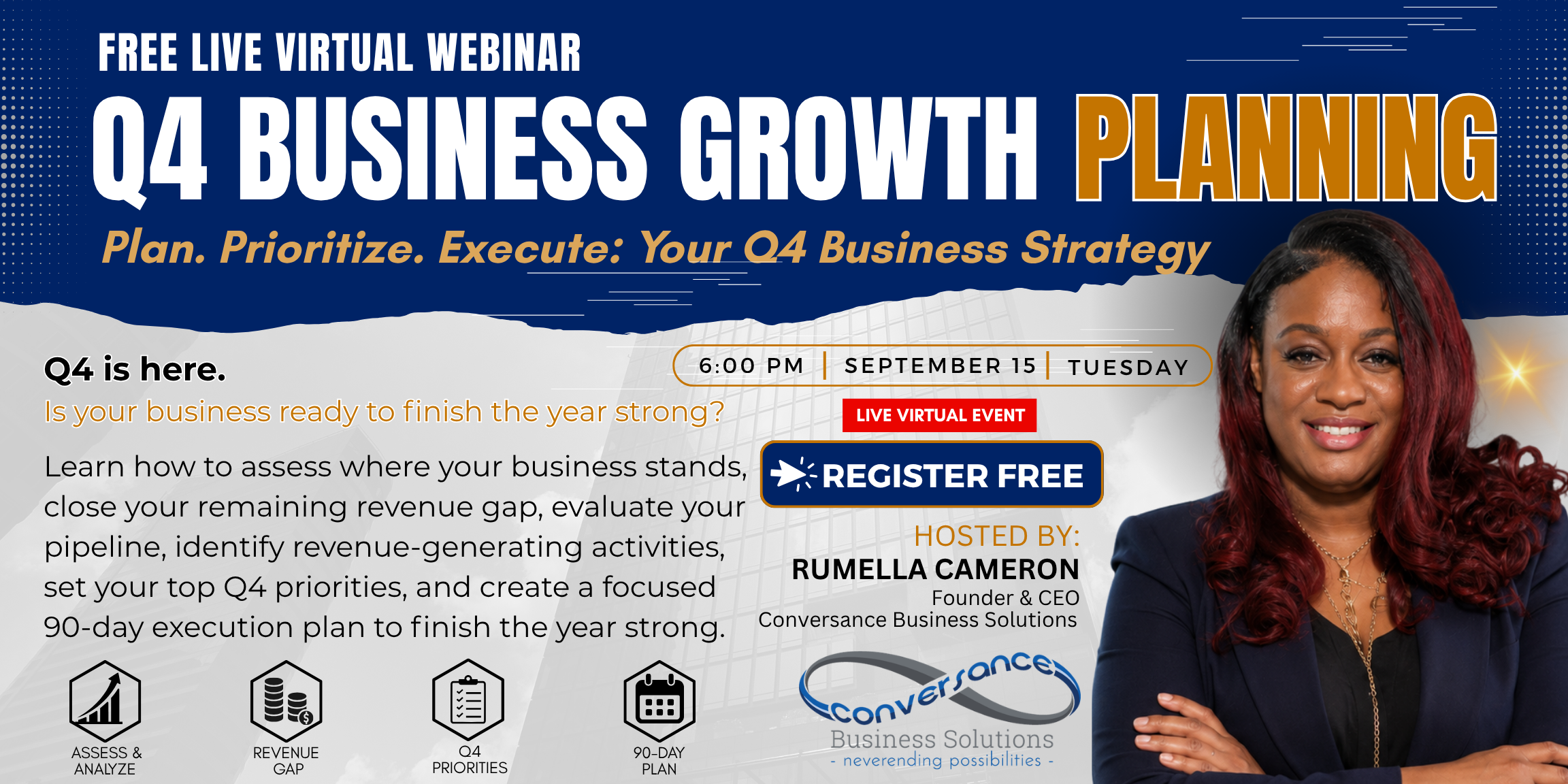
This month, Conversance Business Solutions is taking this conversation further with a live Q4 Business Growth Planning Webinar.
We’ll help business owners assess where their businesses currently stand, identify revenue and pipeline gaps, determine their highest-impact priorities, and begin turning their remaining 2026 goals into a focused Q4 execution plan.
This isn’t about adding another list of things to your plate. It’s about identifying what actually matters during the next 90 days.
Call us at 585-484-0038 or email us at support@conversance.biz to register.
If your company needs more than a plan and you’re looking for strategic and operational leadership to help execute it, our Fractional COO services help growing businesses strengthen operations, establish accountability, manage priorities, and turn strategy into execution.
We hope these tips were helpful!
Get in touch with us today at 585-484-0038 or support@conversance.biz to learn more about the ways in which our team can help you.
Build. Grow. Scale.
Conversance Business Solutions
Neverending Possibilities.