Why Operational Systems Are the Competitive Advantage Most Small Businesses Overlook
Celebrating 11 Years of Helping Entrepreneurs Build Stronger Businesses
Written by Rumella Cameron, Founder & CEO of Conversance Business Solutions
When I founded Conversance Business Solutions in July 2015, I had one mission: to help entrepreneurs turn great ideas into sustainable businesses.
Like many entrepreneurs, I believed success was measured by hard work. Long days, late nights, answering every phone call, responding to every email, and saying “yes” to every opportunity felt like the formula for growth. There is certainly value in determination, resilience, and a strong work ethic. In fact, those qualities are often what inspire someone to leap into entrepreneurship in the first place.
Eleven years later, after working alongside more than a thousand entrepreneurs and business owners across a wide range of industries, I’ve discovered something far more important.
Hard work may start a business.
Operational excellence is what allows it to grow.
Over the past decade, I’ve had the privilege of helping startups launch, guiding established companies through periods of growth, assisting nonprofits with strategic planning, supporting contractors, healthcare professionals, consultants, retailers, and service-based businesses. While every business has its own story, I’ve noticed a consistent pattern.
The businesses that experience sustainable growth are rarely the ones with the biggest marketing budgets or the most employees. They are rarely the businesses chasing every new trend or trying every new strategy.
Instead, they’re the businesses that have intentionally built the operational foundation necessary to support growth.
That foundation isn’t glamorous.
It isn’t often discussed on social media.
It doesn’t generate headlines.
But it determines whether a business scales successfully or struggles under the weight of its own success.


Growth Reveals Every Weakness
Entrepreneurs naturally focus on revenue, and it’s easy to understand why. Revenue keeps the lights on, pays employees, funds expansion, and creates opportunities. Marketing plans, networking events, advertising campaigns, and sales strategies all merit attention as they contribute to business growth. However, every new customer also brings additional responsibilities. Each new service creates extra processes, and every new employee requires communication, accountability, and training.
Growth doesn’t eliminate problems; it magnifies them. I’ve seen businesses celebrate landing their biggest client only to realize they weren’t prepared to manage the increased workload. I’ve witnessed owners spend thousands generating leads without a consistent follow-up process in place. I’ve worked with companies where exceptional employees delivered vastly different customer experiences simply because there were no documented procedures to follow. None of these businesses lacked talent or ambition; they simply outgrew the systems that once supported them. Success exposed operational gaps that had always existed.
As entrepreneurs, we often celebrate growth without asking an equally important question: Can our business actually support the growth we’re pursuing? If the answer is no, then expansion becomes stressful instead of exciting.
Strong Businesses Are Built Before Customers Notice
One of the greatest misconceptions in entrepreneurship is that operational systems are only necessary once a business becomes “large.” In reality, it’s quite the opposite. Businesses should begin documenting, organizing, and improving their operations while they’re still growing. Research consistently supports this reality. According to the U.S. Chamber of Commerce, small businesses represent 99.9% of all businesses in the United States and employ nearly half of the nation’s private workforce. Small businesses drive innovation, job creation, and economic development.
Despite their importance, many entrepreneurs launch businesses with incredible technical skills but little operational structure. They might be exceptional electricians, outstanding accountants, talented consultants, creative marketers, or experienced healthcare professionals. Yet running a successful business requires far more than technical expertise; it requires systems that enable great work to occur consistently.
Without those systems, business owners become the central point for every decision. Every client needs their approval. Every employee asks them questions. Every invoice waits for its review. Every issue lands on their desk. Eventually, the owner becomes the bottleneck, preventing the business from reaching its next level.
Businesses That Scale Think Differently
Over more than a decade of observing various businesses, I’ve noticed that successful companies don’t necessarily work harder; they operate differently. They understand that systems create consistency. Consistency builds trust, and trust fosters growth. Rather than relying on memory, they document procedures. Rather than hoping employees know what to do, they create clear expectations. Rather than reacting to problems, they proactively build processes that minimize mistakes before they happen.
This shift in thinking transforms the way a business operates. Customer inquiries receive timely responses because someone owns the process. New employees onboard more quickly because expectations are documented. Financial reports become decision-making tools instead of just paperwork completed during tax season. Marketing efforts become more effective because leads are consistently followed up. None of these improvements requires revolutionary ideas; they demand intentional leadership.
Operational excellence isn’t about adding unnecessary complexity; it’s about removing unnecessary confusion.

Systems Don’t Limit Creativity—They Create Capacity
One concern I occasionally hear from business owners is that documenting processes might make their business feel rigid or impersonal. My experience shows the opposite to be true. When repetitive tasks are standardized, leaders gain more time to think creatively. When administrative processes are efficient, business owners have more capacity to focus on sales, partnerships, innovation, and long-term strategy.
Systems don’t eliminate the human element; they strengthen it. Instead of constantly putting out fires, leaders can coach employees, build relationships, improve customer experiences, and explore new opportunities. That’s where real growth begins. Operational systems create freedom—not by reducing work, but by enabling business owners to spend their time where they add the greatest value.
Lessons Learned from Helping Over 1,000 Entrepreneurs
As Conversance celebrates eleven years in business, I often reflect on the conversations I’ve had with business owners throughout our journey. While every entrepreneur’s circumstances are unique, several lessons continue to resonate.
Looking Ahead
As entrepreneurs, we naturally focus on what’s next:
– The next client.
– The next project.
– The next goal.
– The next opportunity.
However, sustainable growth requires us to pause and ask a different question:
Is my business prepared for the future I’m trying to create?
Operational systems may not be exciting because they aren’t visible to customers. Yet, they are valuable because customers don’t see them directly. Instead, they experience professionalism, consistency, and confidence when engaging with an organization that knows exactly who it is and how it operates.
As we celebrate eleven years at Conversance Business Solutions, I am incredibly grateful for every entrepreneur, business owner, nonprofit organization, and community partner who has trusted us to be part of their journey. Helping businesses launch, grow, and scale has always involved more than just forming an LLC, writing a business plan, or providing operational support. It’s about helping business owners build organizations that are sustainable, scalable, and positioned for long-term success.
The next stage of your business won’t be determined solely by how hard you’re willing to work; it will also depend on the systems you build today to support the vision you have for tomorrow.
If you’re feeling overwhelmed, operating without documented processes, or wondering how to position your business for its next phase of growth, it may be the perfect time to step back and evaluate your operations. Sometimes, the greatest investment you can make isn’t working harder, but rather building a business that works better.
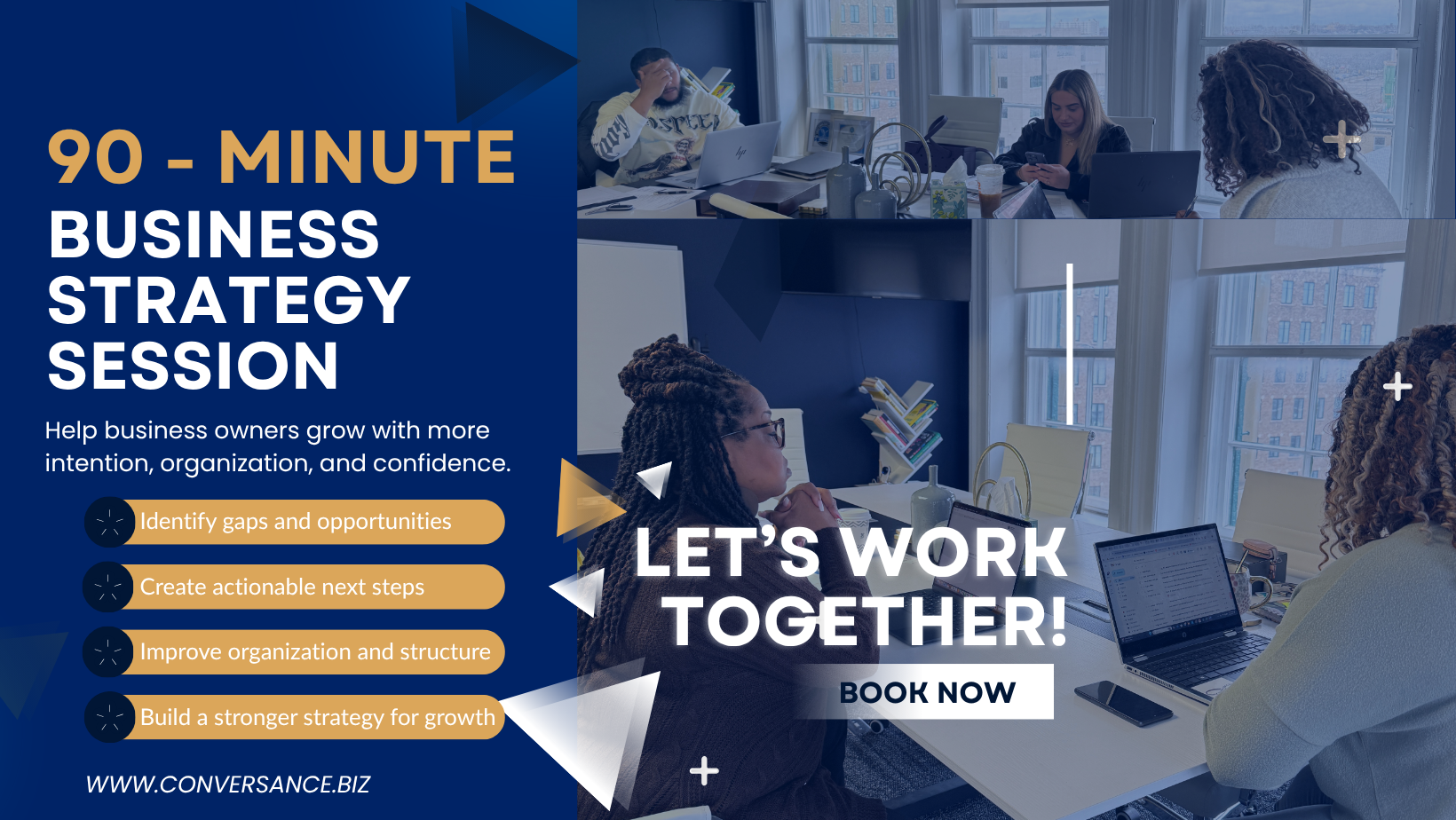
Ready to take the next step? Book a strategy session with Conversance Business Solutions today, and let’s work together to create a roadmap for your business’s future success.
Schedule your Business Strategy Session:
https://calendly.com/conversance/strategy